
Start with the summer, because that's what everyone in Bikaner actually wants to know.
The first question most people here ask about walls isn't strength or price. It's whether the house will be bearable in May.
So let's deal with that honestly before anything else.
What this choice does for your summer
Less than you've been told.
Red bricks and fly ash bricks are both dense, solid masonry. Their insulating performance sits in the same broad band. You'll find fly ash brick sellers quoting dramatically better numbers — figures like a third of red brick's thermal conductivity — and those claims should be treated carefully. Some of them appear to have been borrowed from lightweight aerated blocks, which are a genuinely different product at roughly a quarter the density.
Between a good red brick and a good fly ash brick, any difference in how hot your rooms get is small. Real, possibly. Decisive, no.
What actually governs indoor temperature in a Bikaner house:
- The roof. Your terrace takes the sun for the entire day at the worst angle. Roof insulation or a shaded terrace changes indoor temperature far more than any wall material will.
- Wall thickness. A 9-inch wall behaves considerably better than a 4.5-inch wall, in either material. This is a bigger lever than the brick choice.
- Orientation and shading. Which walls face west, how deep your chajjas are, where the windows sit.
- Cavity or double-wall construction on the worst-exposed faces.
If summer comfort is your priority, spend your attention and your money there. Choose between these two bricks on the grounds below instead — because those are the grounds where they genuinely differ.
(If insulation is a genuine priority, there is a third category — lightweight aerated blocks — that substantially outperforms both. That's a separate conversation and a separate cost bracket.)
Strength
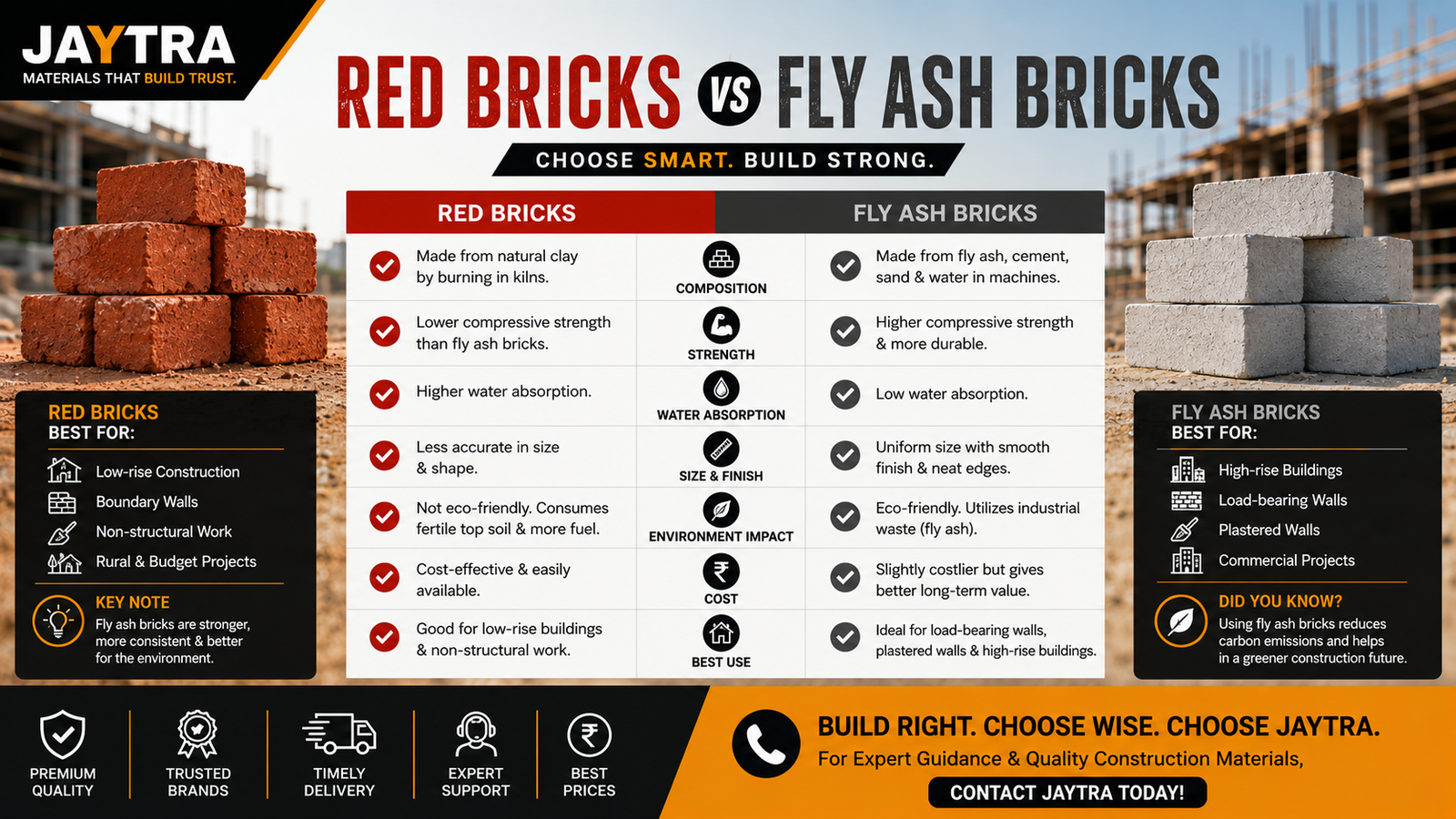
This is where fly ash bricks have a real, standards-backed edge.
Fly ash bricks are covered by IS 12894, which defines Class I at a minimum of 7.5 N/mm² and Class II at 5.0 N/mm².
Clay bricks are covered by IS 1077, which starts its class designations at 3.5 N/mm². Ordinary locally-fired bricks commonly land somewhere between 3.5 and 7.5.
So a Class I fly ash brick starts where a decent clay brick finishes. For load-bearing walls carrying more than a single storey, that margin matters, and it's the main technical reason engineers specify them.
The caveat: those are the standards, not the market. Fly ash brick making has a low barrier to entry, and quality between a properly cured plant product and a roadside operation varies enormously. An under-cured fly ash brick can be weaker than a well-fired clay brick. The class on paper means nothing without a manufacturer who actually meets it.
Water and salt
A widely repeated claim is that fly ash bricks absorb far less water. The standards don't say that — both IS 1077 and IS 12894 permit up to 20% absorption for the lower classes and 15% for higher ones.
In practice, though, good fly ash bricks do tend to absorb less than typical clay bricks, and that has two consequences worth caring about:
Less efflorescence. Those white salty patches that bloom through plaster and paint come largely from soluble salts in clay bricks drawing moisture. Fly ash bricks are generally less prone to it. In areas with brackish groundwater — and parts of this region qualify — that's a genuine advantage.
Less water drawn from mortar. Dry clay bricks pull water out of fresh mortar, which is why they must be soaked properly before laying. Skip that step and the joint is weak. Fly ash bricks need less soaking, though they still need wetting.
The flip side: fly ash bricks have a smoother face, and some masons find plaster and mortar bond less readily to them. Proper wetting and a good mortar mix handle it. An inexperienced crew treating them like clay bricks may not.
Size, mortar and the cost that isn't on the invoice
This is the difference that shows up in your final bill rather than your brick quotation.
Fly ash bricks are machine-pressed to consistent dimensions with sharp edges and flat faces. Hand-moulded, kiln-fired clay bricks vary — in size, in shape, in straightness.
That consistency compounds:
- Thinner, more uniform mortar joints — less cement and sand consumed in the wall.
- Less plaster. A wall of uniform bricks is flatter, so it needs a thinner plaster coat to true up. On a whole house, that's a meaningful quantity of cement and labour.
- Faster laying, because the mason isn't sorting and adjusting for irregular units.
Per brick, fly ash is often priced close to or slightly below red brick. Per finished square foot of plastered wall, the gap usually widens in its favour. Compare completed wall cost, not brick cost — and ask your contractor to quote both ways.
Where each one still wins
Red bricks make sense when:
- You have a trusted local kiln with consistent, well-fired output — a good clay brick is a proven material with centuries behind it.
- Your masons strongly prefer them. Crew familiarity is worth something real on site.
- You're doing exposed brickwork, where the colour and texture are the point.
- You need small quantities, repairs, or matching to existing work.
Fly ash bricks make sense when:
- You're building load-bearing walls beyond a single storey and want the strength margin.
- You want lower plaster and mortar consumption across a large wall area.
- Efflorescence has been a problem in your area.
- You can buy from a plant whose product you can actually inspect.
How to judge either one before you buy
The same discipline works for both:
- Ask for the test report — compressive strength and water absorption. A serious manufacturer of either type has one.
- Check dimensional consistency. Stack ten. Uneven heights mean uneven joints and more plaster.
- Drop one from about waist height onto hard ground. A sound brick survives or breaks cleanly; a poorly made one crumbles.
- Look at the colour and the ring. A well-fired clay brick is uniform in colour and rings when struck. A dull thud suggests under-firing.
- For fly ash, ask how long it was cured. Under-curing is the single most common failure, and it isn't visible.
The short version
Neither brick will fix a Bikaner summer — your roof, wall thickness and shading will. On strength, fly ash has the standards advantage. On finished wall cost, fly ash usually wins once mortar and plaster are counted. On reliability, a good clay brick beats a bad fly ash brick every time.
Choose the manufacturer before you choose the category.
JAYTRA Bricks, cement, TMT, tiles, paint, hardware, electricals. Sagar Road, near Haldiram Pyau, Tilak Nagar, Bikaner. +91 7665544800 · www.jaytra.com
Samples of both on display at the showroom. Bring your wall area and we'll work out quantities for either.