
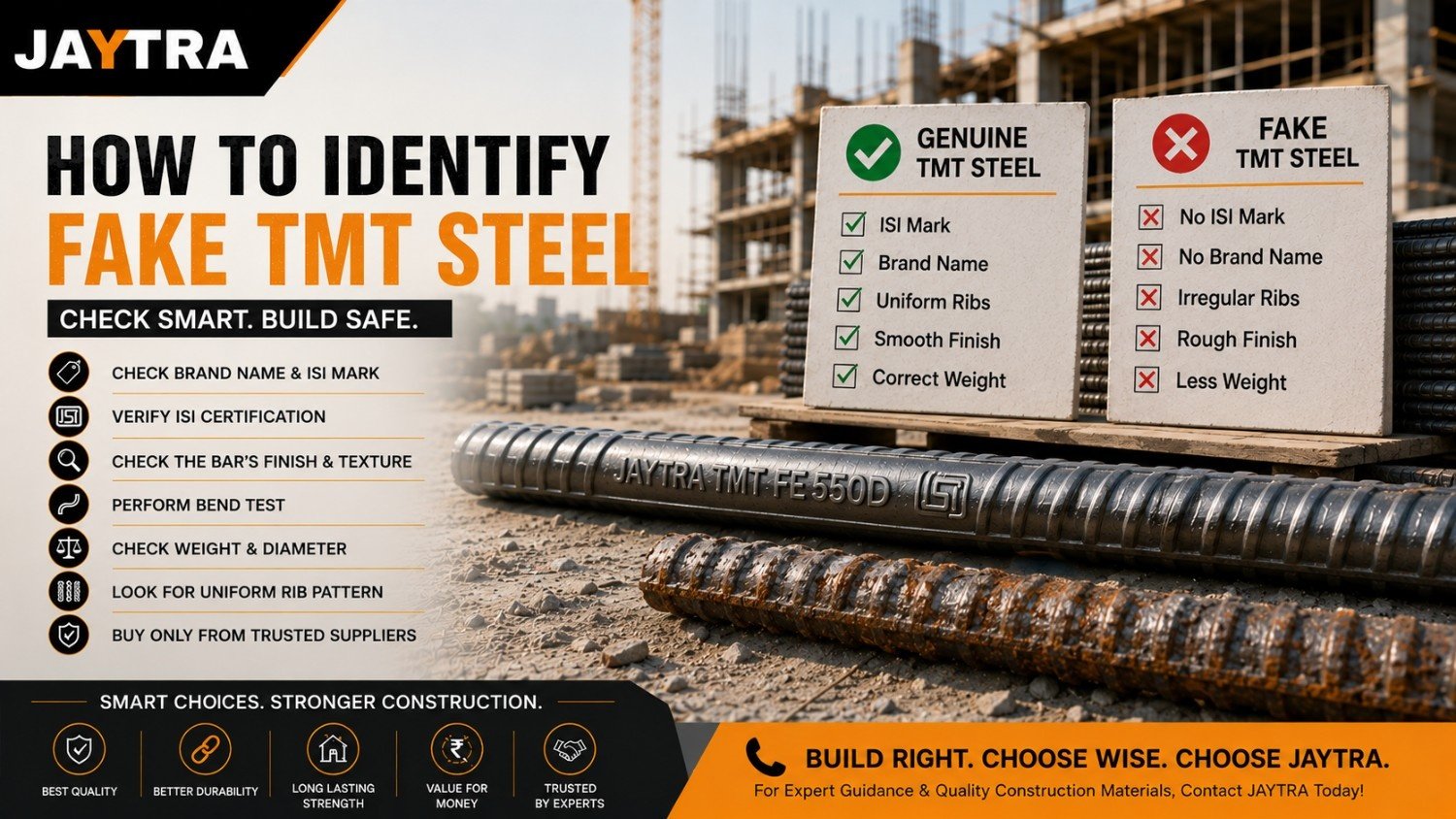
Five checks, ten minutes, at the gate. No lab required for four of them.
Start with the word.
"Fake steel" suggests someone is selling you painted bamboo. Nobody is. What arrives on a truck is always steel.
What varies — and what actually costs people money — is smaller and harder to see:
- Bars lighter than the diameter they're sold as. Steel is priced by weight; a bar rolled slightly thin looks identical and quietly shorts you on every metre.
- Bars sold as a grade they aren't. Fe 500 invoiced as Fe 500D. The mark is stamped, so who's checking?
- Bars from a secondary re-rolling mill carrying a primary producer's mark.
- Bars that were never properly quenched — rolled steel wearing the TMT name without the treatment that makes TMT worth buying.
None of that is exotic. All of it is checkable. Here's how, in the order of how much each check is worth.
Check 1: The bundle tag, and the app that verifies it
This is the strongest check available to you, and almost nobody uses it.
TMT bars sold in India fall under mandatory BIS certification. Every legitimately certified bundle carries a tag showing the manufacturer, grade, diameter, heat or batch number — and a CM/L number, which is the licence number BIS issued to that manufacturer for that product.
That licence number can be verified against the government's own database, free, from your phone.
How:
- Install BIS Care — the official Bureau of Indian Standards app, on Android and iOS. It's free.
- Open it and tap Verify Licence Details.
- Enter the CM/L number from the bundle tag.
A valid licence returns the manufacturer's details. Nothing returned means one of three things: the number was mistyped, the licence has been cancelled, or that number was never issued.
Take thirty seconds and check it. A counterfeiter can copy a logo onto a bar. Copying a licence number that survives a lookup in BIS's own records is a different problem entirely.
Keep the tags. All of them, until the structure is complete. They're your only link between what was promised and what was poured.
Check 2: The marks on the bar itself
Every genuine bar carries the manufacturer's mark and the grade rolled into the steel — raised, formed during rolling, repeating along the entire length.
Not printed. Not painted. Not on a sticker.
Run your hand along a bar and find them. Then check three things:
- They repeat consistently down the full length, not just near the ends.
- The grade shown matches your invoice. If you ordered Fe 500D, the bar should say so — the "D" is part of the rolled mark, not an assumption.
- The impression is crisp. Shallow, smeared or inconsistent marks are a warning.
Check 3: Weigh it
The most common shortfall, and the easiest to catch.
Cut a clean one-metre length and weigh it. It should come close to:
Diameter Weight per metre 8 mm 0.395 kg 10 mm 0.617 kg 12 mm 0.888 kg 16 mm 1.580 kg 20 mm 2.470 kg 25 mm 3.850 kgThe standard allows a margin: up to 4.5% below on any single bar, and no more than 3% below on the average of a sample. Steel isn't rolled to perfection and small variation is normal.
Beyond that, it isn't within spec — and since you're buying by weight, a consistent shortfall across a delivery is money leaving in a direction you can measure.
Weigh three or four bars, not one. A single light bar proves nothing. A pattern proves plenty.
Check 4: The cut face — the one test that settles it
This is the definitive check for whether a bar is genuinely thermo-mechanically treated at all, and it's the one you'll rarely see mentioned.
Real TMT is made by quenching the hot bar's surface with water while the core stays hot. That produces a hard outer ring with a softer, more ductile core — two distinct zones in the same bar. The hard ring gives strength. The soft core gives the stretch that makes the bar forgiving.
Cut a bar cleanly across and file the face smooth. On a good bar, the outer ring is visible as a distinct band around a different-looking centre, and it should be:
- Continuous — unbroken all the way around.
- Even in thickness — not thick on one side and thin on the other.
- Centred — the core sitting in the middle, not pushed off to one edge.
A ring that's patchy, uneven or off-centre means the quenching was done badly. A bar with no visible ring at all was never properly treated, whatever the mark says.
Seeing this clearly on a filed face takes a good eye and good light. A testing lab can etch the face and show it unmistakably, and if you're pouring columns for more than two floors, that's a test worth paying for once, on the first consignment.
Check 5: Bend one
Take an offcut and bend it hard around something round.
Genuine TMT bends smoothly and holds the bend. Poorly made or brittle re-rolled steel cracks at the outside of the bend, or shows fine surface fissures opening along the curve.
Any cracking at a normal bend radius is a reject. Your bar bender will usually spot this before you do — ask them. They bend a hundred bars a day and they know immediately when a consignment is behaving wrong.
While you're looking: the ribs should be uniform and sharp along the full length. The ribs are what grip the concrete. Faded or missing ribs in patches mean careless rolling.
Keep the paperwork
Three things, kept together in one folder until the building is finished:
- The bundle tags.
- The invoice, showing grade and diameter explicitly.
- The mill test certificate for the batch, if you're buying in quantity — ask for it. The heat number on the certificate should match the heat number on the tag.
If a question ever arises about the structure — during a sale, an insurance claim, or a dispute — this folder is the answer. It costs nothing to keep and it cannot be reconstructed later.
The ten-minute version
Verify the CM/L number on the app. Read the rolled marks and check the grade against your invoice. Weigh three bars. Bend an offcut. Keep the tags.
Do that once per delivery and you've eliminated nearly every way this goes wrong.
Choosing the grade in the first place? See Fe 500 vs Fe 500D vs Fe 550 vs Fe 600. Working out quantity and storage? See Which TMT Bar is Best for Home Construction.
JAYTRA TMT, cement, tiles, paint, hardware, electricals. Sagar Road, near Haldiram Pyau, Tilak Nagar, Bikaner. +91 7665544800 · www.jaytra.com
Every delivery leaves with its tags and its invoice. Ask us for the test certificate any time.