
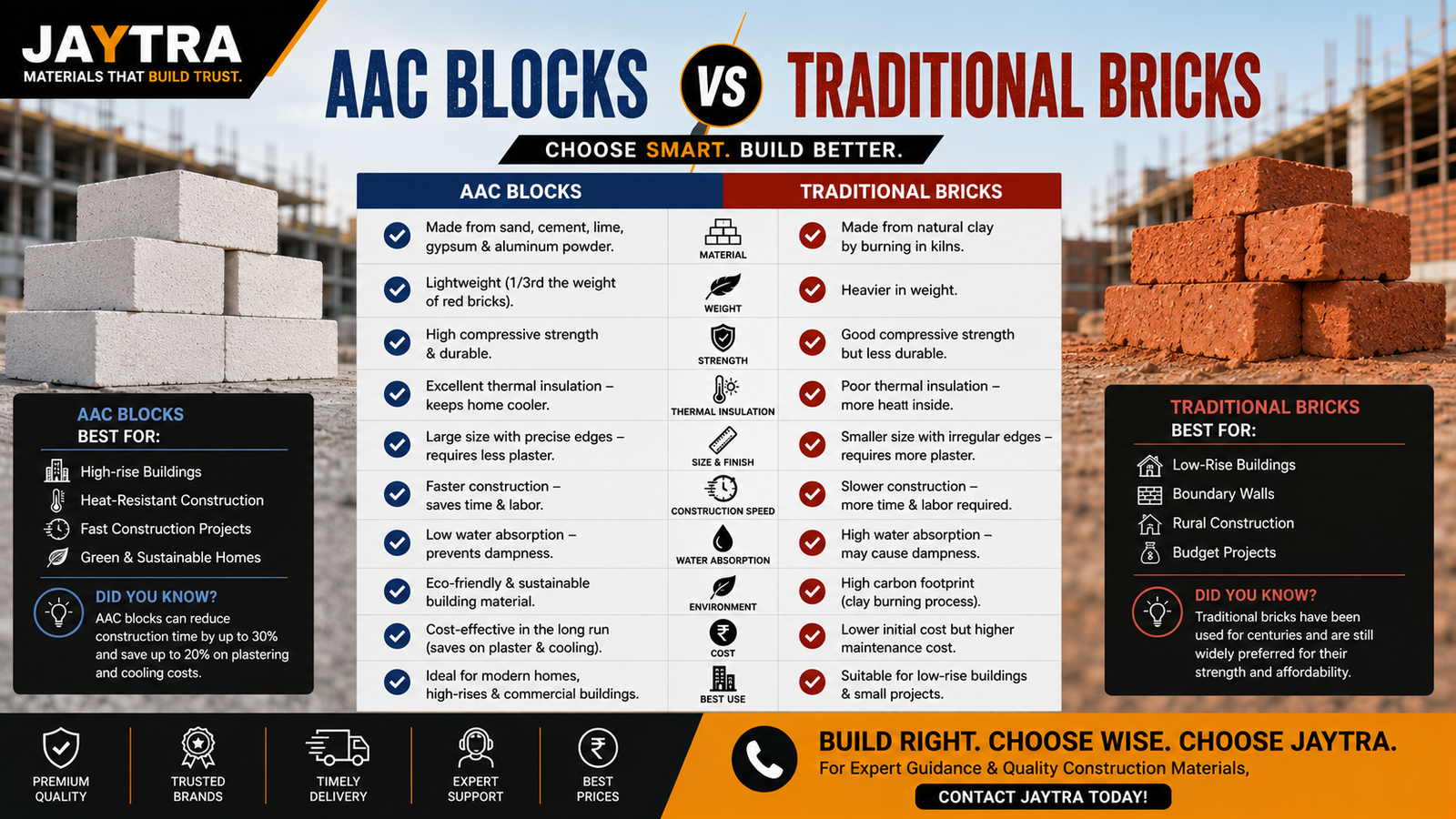
A real comparison, including the three things about AAC that nobody selling it will mention.
First, a question that settles this for some readers
Is your house a load-bearing structure, or an RCC frame?
If the walls carry the roof — no columns and beams, masonry doing the structural work — then AAC is probably not your material. Its compressive strength sits below what a Class I fly ash brick delivers, and load-bearing walls are exactly where that margin is spent.
If that's your house, this comparison isn't the one you need. Read Red Bricks vs Fly Ash Bricks instead.
If you're building an RCC frame — columns and beams carrying the load, walls filling the gaps — then read on. That's where AAC belongs, and where it has genuine advantages worth paying for.
What AAC actually is
Autoclaved aerated concrete. Cement, lime, sand and a foaming agent, cured under steam pressure. The foaming creates millions of tiny sealed air pockets through the material.
Those air pockets are the entire story. They make the block roughly a third the weight of a clay brick and give it insulating properties no solid masonry can match — and they're also the reason for every one of its drawbacks.
The numbers
AAC block Clay brick Fly ash brick Density 550–650 kg/m³ ~1,800 kg/m³ ~1,800 kg/m³ Compressive strength 3–4+ N/mm² 3.5–7.5+ N/mm² 7.5+ N/mm² (Class I) Thermal conductivity 0.16–0.24 W/mK ~0.6–1.0 W/mK ~0.6–1.0 W/mK Water absorption limit 10% by mass 20% 20% Standard IS 2185 (Part 3) IS 1077 IS 12894Look at the thermal row. AAC conducts heat at roughly a quarter the rate of either brick. That is not a marketing gap — it's a different order of material, and it's the one comparison in all of this walling business where the difference is genuinely decisive.
Where AAC genuinely wins
Heat. In a city where May and June decide how you feel about your house, a wall that transmits a quarter of the heat is a real change in living conditions and running costs. This is the reason to consider AAC in Bikaner, and it's a good one.
Weight — and what it does to your structure. An AAC wall weighs about a third of a brick wall. That dead load travels down through your beams, columns and footings. A lighter building needs a lighter frame: potentially smaller sections, less concrete, and less steel. On a multi-storey house the structural saving can offset a meaningful share of the material premium. Ask your structural engineer to price the frame both ways before you decide — most people never do, and it's the calculation that most often changes the answer. (See How Much Steel is Required for a House?.)
Speed. One AAC block replaces roughly eight or nine bricks. Fewer units, fewer joints, faster walls.
Straightness. Factory-cut to close tolerances, so walls come out flat and plaster coats stay thin.
The three things nobody selling AAC will tell you
This is the section that matters. None of these are reasons to reject AAC. All of them are reasons people end up disappointed by it.
1. You cannot hang things on it normally
This is the complaint that surfaces months after everyone has moved in.
Ordinary wall plugs and screws — the kind that hold fine in brick — pull straight out of AAC under load. The material is light and porous; a standard anchor has nothing to grip. Wall-mounted geysers, split AC indoor units, heavy wall cabinets, TV brackets, kitchen units: all of them need anchors specifically designed for aerated concrete, and the heaviest need provisions planned into the wall before plastering.
What to do: decide early where geysers, ACs, TVs and heavy cabinets will go, and tell your contractor. Solid inserts or a brick patch at those locations, planned in advance, costs almost nothing. Discovering the problem when the geyser is on site costs a great deal more in irritation.
2. Ordinary cement mortar cancels the main benefit
AAC must be laid in thin-bed adhesive — a polymer-modified jointing mortar applied at roughly 2 to 3 mm.
Laid in conventional cement-sand mortar at 12 to 15 mm, two things go wrong. The mortar bonds poorly to AAC's porous surface, so joints are weak. And more importantly, every one of those thick dense joints becomes a thermal bridge — a path for heat straight through the wall, bypassing the insulation you paid for.
Build an AAC wall in ordinary mortar and you have spent premium money to obtain an ordinary wall. This happens routinely, because it's what crews are used to doing.
What to do: specify block jointing mortar in writing, budget for it, and check on site that it's what's being used. This single point decides whether AAC was worth it.
3. It needs the right plaster, and a crew that has done it before
AAC's surface takes plaster differently from brick. Conventional thick cement plaster is prone to cracking on it; polymer-modified plaster is the standard answer.
Beyond materials, there's simple familiarity. A crew that has laid AAC before will get thin-bed joints right, handle cutting cleanly, and know where fixings need provisions. A crew doing it for the first time on your house will learn on your house.
What to do: ask directly whether your masons have worked with AAC. If they haven't, that's not disqualifying — but the supervision needs to be closer for the first few days, and someone needs to be checking joint thickness.
A fourth, smaller point: water
AAC is porous, and porosity plus moisture is not a good combination. IS 2185 caps water absorption at 10% by mass, which is tighter than the brick standards allow — but AAC that does get saturated loses thermal performance and dries slowly.
In practice this is handled the same way you'd handle any wall: sound external plaster, proper waterproofing at the plinth and at parapet junctions, and no bare blocks left exposed to weather during construction. In a dry climate it's a modest concern, provided the external finish is done properly.
The honest cost picture
Per unit of wall, AAC costs more than brick. That's the number people compare, and by itself it's misleading.
Set against it:
- Less mortar — thin-bed joints use a fraction of the volume, though the adhesive costs more per kg.
- Less plaster, because the walls are flatter.
- Faster labour, because there are fewer units to lay.
- Potentially a lighter, cheaper structure — the biggest single offset, and the one most often ignored.
Against that, add the cost of proper anchors and any fixing provisions.
Which way it nets out depends on your building's height, your frame design and your labour rates. It is a calculation, not a rule — and for a single-storey house the structural saving is small, which weakens the case considerably. AAC makes most sense as you go up.
The short version
If you're building load-bearing, use bricks. If you're building an RCC frame in a climate like Bikaner's, AAC's thermal performance is a genuine, measurable improvement — a quarter the heat transfer of brick.
But it only delivers that if it's laid in thin-bed adhesive, and you have to plan your fixings before the plaster goes on. Get either of those wrong and you've paid extra for an ordinary wall.
Also in this series: Red Bricks vs Fly Ash Bricks · How Much Steel is Required for a House?
JAYTRA Blocks, bricks, cement, TMT, tiles, paint, hardware, electricals. Sagar Road, near Haldiram Pyau, Tilak Nagar, Bikaner. +91 7665544800 · www.jaytra.com
If you're weighing AAC, come and see a block. Bring your wall area — we'll work out quantities, jointing mortar and the anchors you'll need, in one list.